
Antennas are core components that enable wireless communication, data transmission, and positioning functions in industrial and IoT devices. Different antenna types and designs are required depending on specific application fields and scenarios. This IoT Antenna Types & Selection Guide covers Common Industrial IoT Antennas Types, with our handy IoT Antenna Selection Quick Guide to help engineers make faster decisions. The following section provides an analysis and recommendations for antenna selection based on various application scenarios, communication protocols, device forms, and operating environments.

Contact Us for IoT Antenna Types & Selection Guide
For more information on IoT antenna types and selection, please contact us at:
Email: [email protected]
Whatsapp: (86)17394732293
IoT Antenna Types & Selection Guide——A Comprehensive Analysis:
In the current wave of development driven by IoT and 5G technologies, our lives are evolving at an unprecedented pace. The application of advanced technologies is making our daily lives smarter, more efficient, and more convenient. Smart homes and smart cities are no longer distant concepts or futuristic visions, but practical blueprints that are being steadily implemented.
From industrial manufacturing and transportation to smart devices and high-speed networks, these technologies have become deeply integrated into every aspect of our lives. Among them, one of the most critical technologies is antenna technology, which serves as the essential bridge for wireless data transmission and reception.


1. Smart Manufacturing and Industrial Automation
- Applications:
Interconnection and data acquisition among PLCs, industrial robots, AGVs (Automated Guided Vehicles), and MES systems. - Antenna selection:
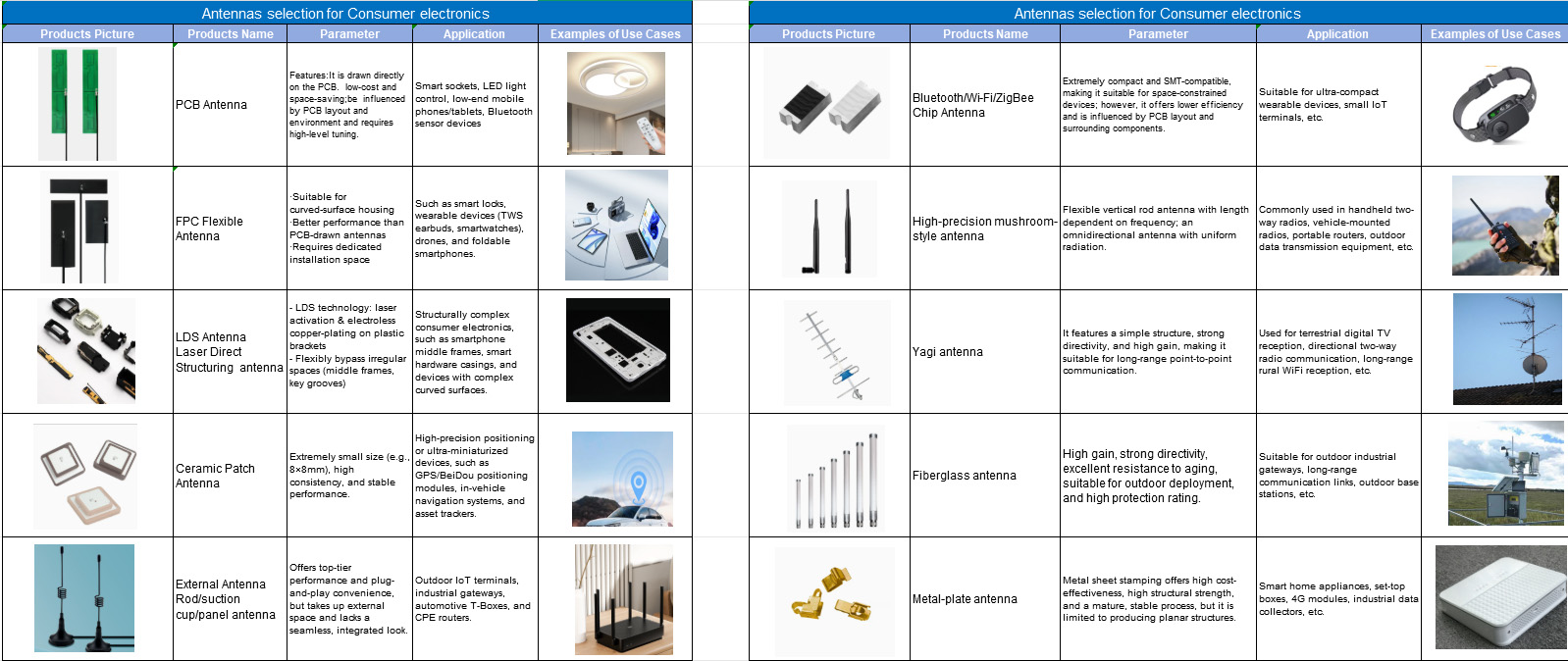
PCB antennas or FPC antennas are commonly used for internal device integration, offering space-saving designs and strong resistance to electromagnetic interference. High-gain omnidirectional or directional antennas (such as fiberglass antennas and rubber duck antennas) are also widely applied to achieve wide-area coverage within workshops and enable real-time AGV positioning. These antenna solutions meet the requirements of high-throughput and low-latency communication in industrial environments.
2. Power and Energy (Substations, Photovoltaic Power Plants, Wind Farms)
- Applications:
Remote data transmission between equipment and dispatch centers, as well as monitoring of unmanned substations and remote sites. - Antenna Selection:
External high-gain antennas (such as fiberglass antennas and rubber duck antennas) are commonly used. These antennas feature waterproof, dustproof (IP67-rated), and high-temperature-resistant designs, enabling reliable operation in harsh outdoor environments and ensuring stable long-distance wireless communication.


3. Smart Logistics and Warehousing
- Application Scenarios:
AGV navigation, goods tracking, and warehouse environment monitoring. - Antenna Selection:
Omnidirectional antennas (such as rubber duck antennas) or MIMO (Multiple Input Multiple Output) antennas are commonly used to provide seamless wireless coverage throughout the warehouse. These solutions ensure stable communication between AGVs and control centers, as well as between scanning devices and management systems, enabling efficient and reliable smart warehouse operations.
4. Smart Meters and Remote Meter Reading (Water, Electricity, and Gas Meters)
- Application Scenarios: Low-power, wide-area data transmission in weak-signal environments such as outdoor areas, basements, and underground facilities.
- Antenna Selection:External short antennas or rubber duck antennas (such as NB-IoT/LoRa antennas) are commonly used. These antennas provide strong signal penetration and low-power communication capabilities. They also require an IP67 waterproof design to withstand complex outdoor environments and ensure stable long-term operation.