
The differences between 5g and lte
What is a 4g lte antenna ?
The 4g lte antenna is a radio-frequenct (RF) Device designed specially for fourth-generation mobile communication (4g lte, or Long Term Evolution)systems.Its primary function is to convert electrical signals from the base station’s RF module into electromagnetic waves for transmission through the air, as well as to receive signals returned by terminal devices.
From an engineering perspective, the typical characteristics of 4g antennas are:
- Frequency coverage: 698MHz–2700MHz;
- Mainly features ±45° dual-polarized design;
- Widely applied in macro base stations, micro base stations and indoor distribution systems;
- Typical types: directional panel antennas, omnidirectional cylindrical antennas and sector antennas;
As 4G networks emphasize wide coverage and high data rates, their antenna designs prioritize radiation uniformity and a low standing-wave ratio to ensure stable signal propagation across diverse environments, such as urban and rural areas.
What is 5g antennas ?
5g antennas are critical RF front-end components in fifth-generation mobile communication systems, tasked with handling higher frequencies, greater bandwidths, and more intelligent beam management.
It is not merely a radio unit; it is a “core interface” for network intelligence and capacity enhancement.
Typical characteristics of 5G antennas include:
- Supports a wider frequency range: 3300–5000MHz (Sub-6GHz), and some systems cover 24GHz–40GHz (millimeter wave)
- Mostly adopts Massive MIMO (Massive Multiple-Input Multiple-Output) architecture
- Integrated with Active Antenna Unit (AAU) modules internally
- Enables dynamic beam-forming and spatial multiplexing
lte vs 5g: The Frequency Bands and Bandwidth Differences
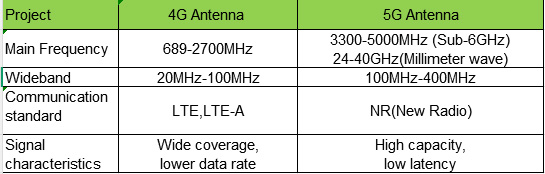
The differences between 5g and lte:While 4g lte antenna primarily serve traditional LTE systems, 5G antennas must maintain high gain and low interference within high-frequency bands. 5g or the better, is 5g or lte faster. Since propagation loss increases with frequency, 5G antennas often employ directional array designs to concentrate energy and enhance effective coverage.
Antenna Types and Structural Design
1. Common antenna types of 4g lte antennas
- Panel Antenna: Highly directional; commonly used for macro base stations.
- Omni Antenna: Provides uniform coverage; used for small cells or indoor distributed antenna systems.
- MIMO Antenna (Multiple-Input Multiple-Output): Increases channel capacity and reduces interference.
2.Common antenna types of 5g antenna
- Massive MIMO Antenna: Integrates dozens to hundreds of antenna elements;
- Active Antenna System (AAS): Integrates the antenna and amplifier into a single unit;
- Beamforming Antenna: Capable of dynamically adjusting beam direction;
- Sub-6 GHz Antenna: Used for mainstream commercial 5G networks;
- mmWave Antenna: Deployed in high-density areas and FWA systems.
lte vs 5g: Comparison of Performance Advantages
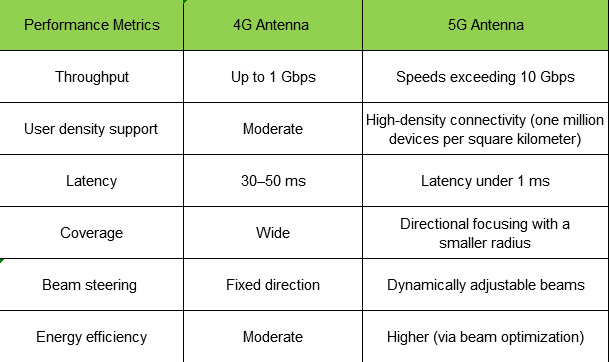
The performance differences between 5g and lte antennas are mainly reflected in operating frequency, array technology, throughput and latency. LTE antennas cover 700MHz–2.7GHz bands, adopt limited 2×2/4×4 MIMO with fixed sector or omnidirectional radiation, delivering stable coverage and moderate speed. 5G antennas support a much wider spectrum including sub-6GHz and mmWave (24GHz+), equipped with Massive MIMO and beamforming. They can dynamically focus radio beams toward terminals, bringing much higher peak data rates, lower latency and larger network capacity. However, mmWave 5G antennas have weaker penetration and shorter signal range compared with LTE antennas. In short, 5G antennas are faster for high-demand scenarios, while LTE antennas remain better for wide-area stable coverage.