How Does an Antenna Work?
Wondering how does an antenna work? We explain antenna energy conversion, electromagnetic radiation, energy loss and radiation efficiency using an intuitive water pool analogy:
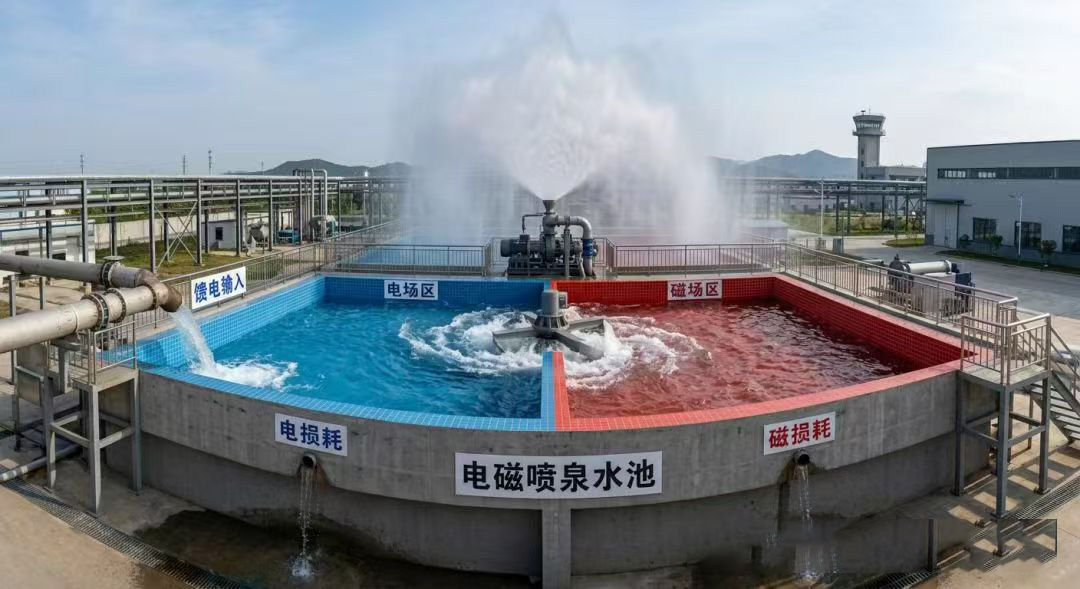
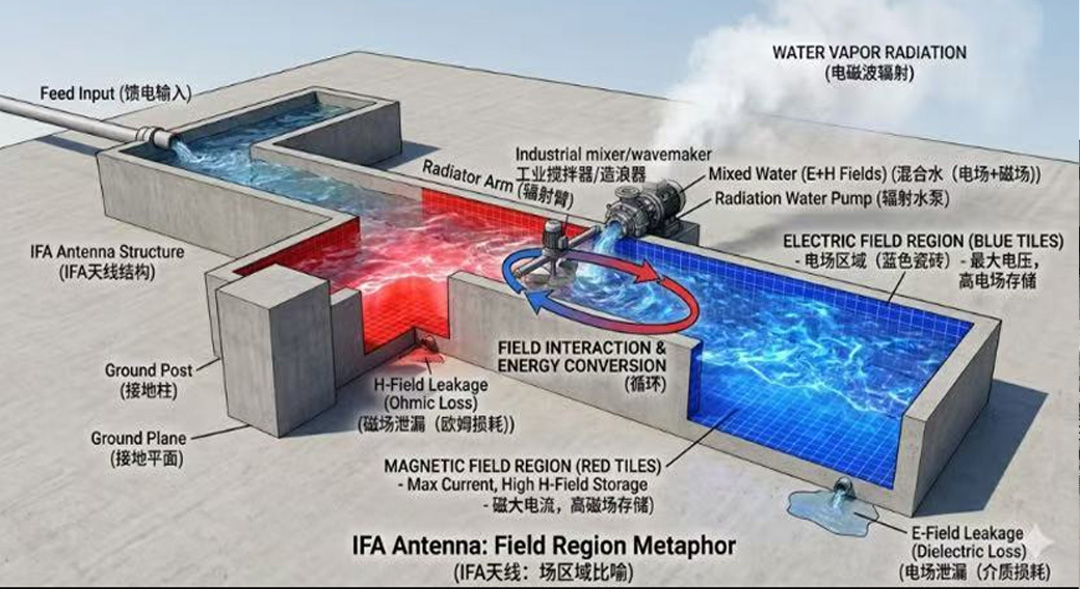
- Think of the antenna as a dynamic energy-storage pool.
- The energy feed is like an inlet continuously supplying water into the pool.
- The conversion and storage of field energy are represented by the electric-field zone, shown by the blue tiles, and the magnetic-field zone, shown by the red tiles. Driven by the wave generator, the water continuously circulates between the two zones.
- At the bottom of the electric-field zone, hidden outlets represent the inevitable electrical energy losses.
- The magnetic-field zone also has outlets, representing magnetic losses caused by energy interaction.
- At the junction between the two zones, a radiation pump draws out the alternating water flow and turns it into water vapor, which then disperses into the void.
- The ultimate purpose of this structure is to transform every drop of injected energy into something that eventually radiates away into the surrounding space.
Energy Injection, Conversion, Loss, and Radiation
In this system, the key processes we need to understand are energy injection, conversion, loss, and final radiation.
Just as the size of a water pool determines how much water it can store, the size of an antenna determines its energy-storage capacity as well as its natural resonant frequency.
The pool inlet represents the antenna’s feed port. Impedance matching can be compared to how well the inlet pipe fits the connection. If the connection is not properly sealed, water will leak out elsewhere, meaning that energy cannot be efficiently delivered into the system.
Field Energy Conversion and Storage: Electric Field & Magnetic Field
The blue-tile area represents the accumulation of electric potential energy, while the fluctuations of the water surface represent the accumulation and movement of electric charge.
The red-tile area represents the release of kinetic energy, while the flowing water represents the oscillation of electric current.
The wave generator in the pool drives the water to circulate continuously, representing the repeated conversion of energy between the electric field and magnetic field. The more intense the water flow between the two regions, the stronger the energy exchange and the more pronounced the resonance.
The Engineer’s Task: Minimize Antenna Energy Loss
The main task of an antenna engineer is to optimize the antenna structure and manufacturing process to minimize the two leakage points and reduce energy loss as much as possible.
Core Antenna Function: Electromagnetic Radiation
At the junction between the red and blue regions sits the core component of the entire system—the high-power radiation pump.
The purpose of this pump is not simply to drive the water circulation, but to capture the most active portion of the energy and extract it from the water surface. Through the atomizing nozzle, the water is instantly transformed into water vapor—representing electromagnetic waves—and radiated into the surrounding space.
Ultimate Goal of Antenna Design: Maximize Radiation Efficiency
The purpose of antenna design and tuning is to achieve the best possible performance through precise tuning and structural optimization, while minimizing energy lost through the leakage points and maximizing the amount of energy converted into electromagnetic radiation.