
[Phased Array Antenna Thesis from the University of Electronic Science and Technology of China] Two-Dimensional Wide-Angle Scanning Phased Array Antenna Employing Hybrid Patch Mode Technology
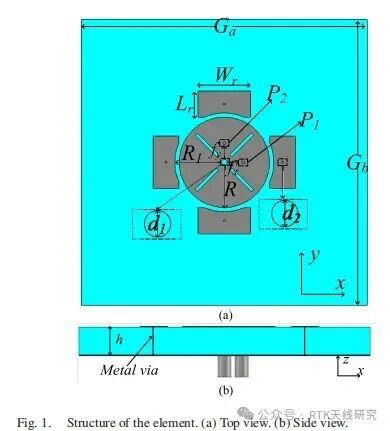
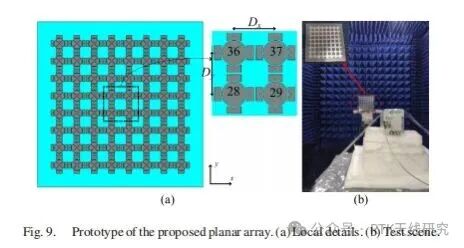
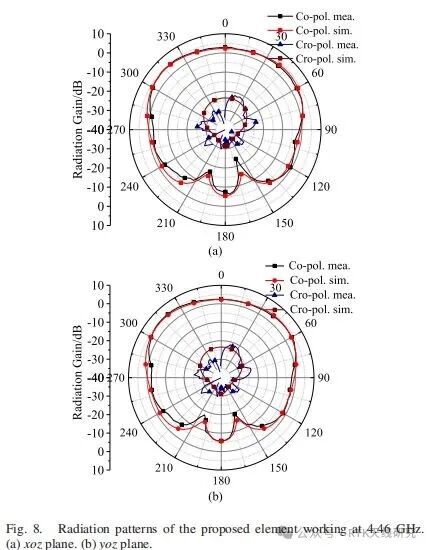
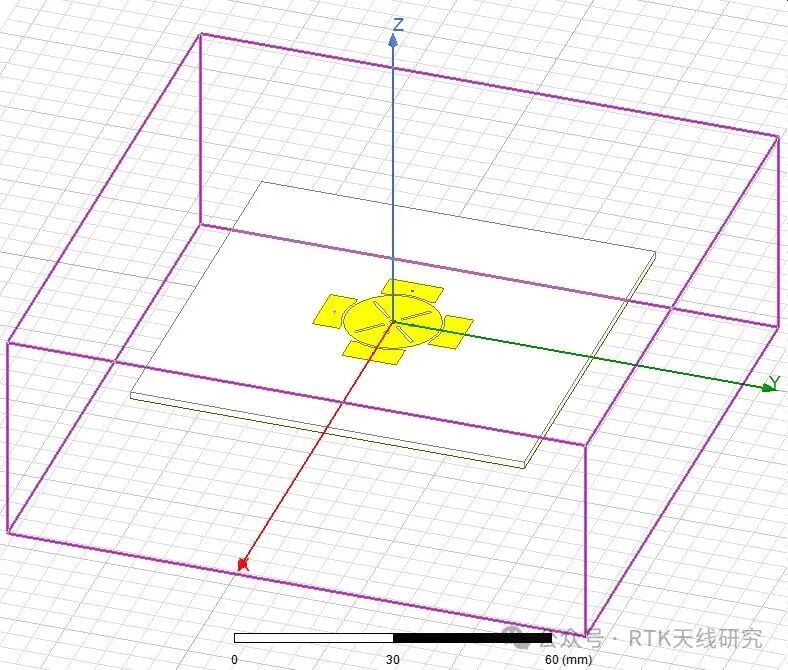
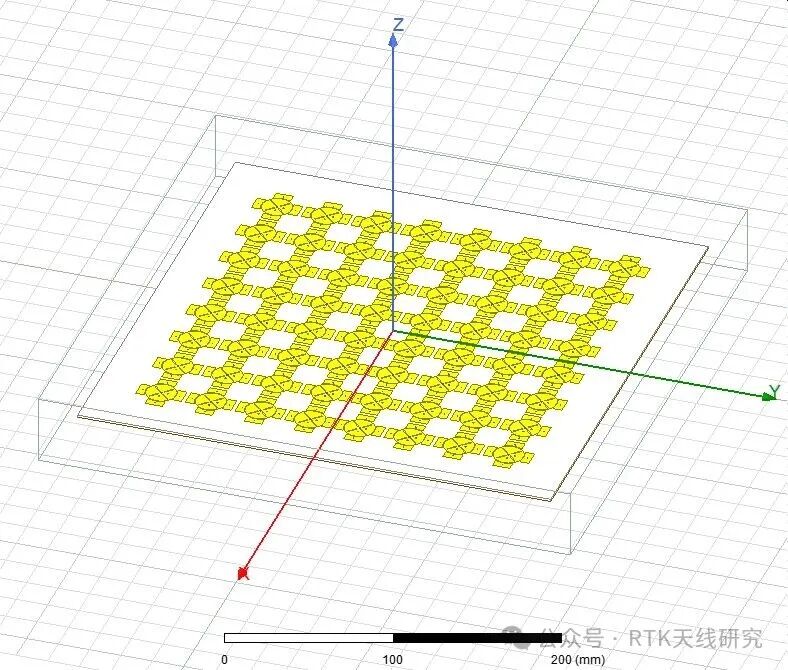
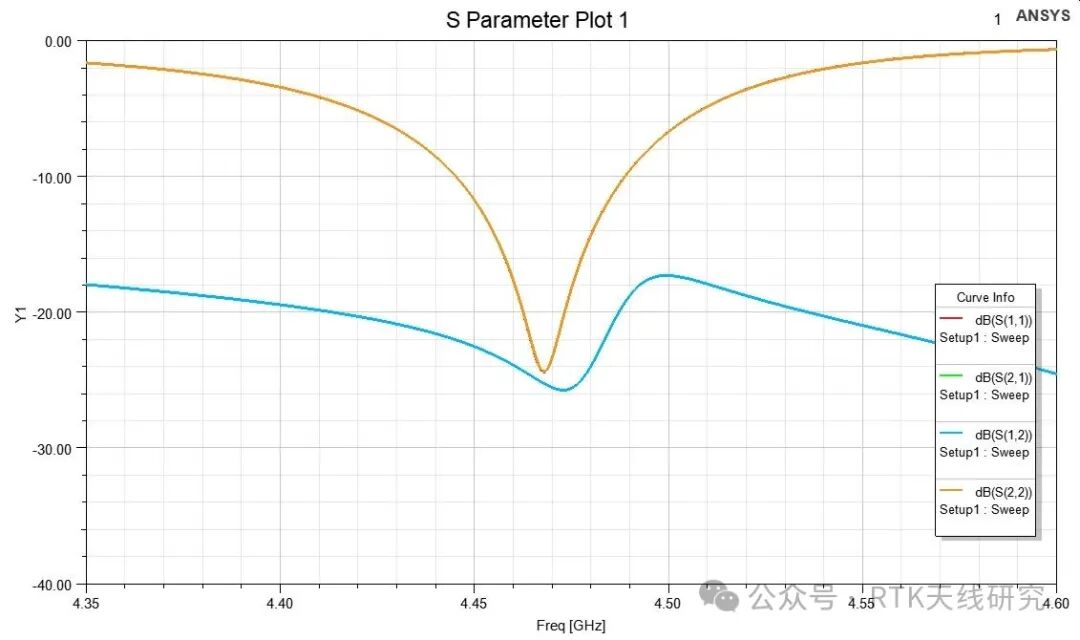
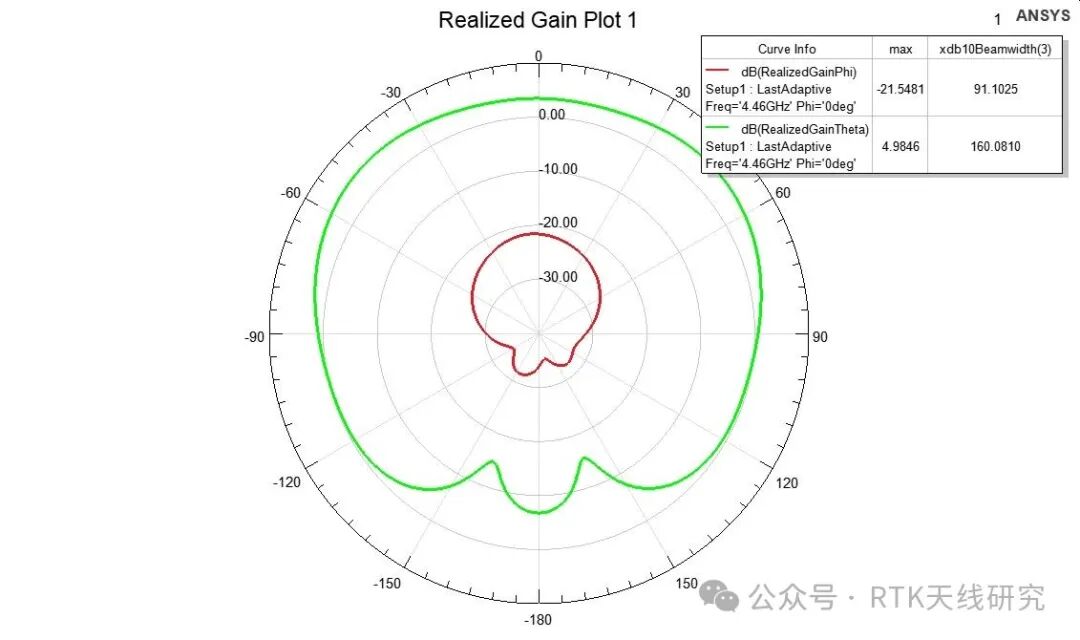
Abstract —Phased array antenna technology is widely used in modern wireless communication, radar, and satellite communication systems. This paper presents a microstrip patch hybrid-mode technique for designing a two-dimensional wide-angle scanning planar phased-array antenna. The proposed unit cell consists of a circular patch surrounded by four rectangular parasitic patches. To achieve a wider radiation beamwidth (BW) in two orthogonal azimuth planes, the TM₁₁ mode of the circular patch and the zeroth-order resonant (ZOR) mode of the rectangular parasitic patches are excited, respectively. Experimental results show that the proposed unit cell achieves a 3-dB beamwidth greater than 156° in both orthogonal azimuth planes. An 8×8 planar phased array based on this unit cell achieves a wide-angle scanning range of approximately ±65° in both orthogonal azimuth planes. Within this scanning range, the sidelobe level remains below −7.8 dB, while the scanning gain variation is less than ±1.73 dB. Moreover, the dominant polarization in both orthogonal planes is θ-polarization. The proposed phased-array antenna features a simple structure, low profile, and ease of fabrication.
Keywords —Phased array, wide-angle scanning, wide beamwidth (BW), zeroth-order resonance (ZOR).
Applications of Phased Array Antenna Technology
Phased array antenna Phased array antenna technology has become an important solution for modern wireless communication, radar, satellite communication, aerospace, and intelligent electronic systems. Unlike conventional antennas that rely mainly on mechanical movement or fixed radiation patterns, a Phased array antenna uses multiple antenna elements and electronic phase control to steer the beam rapidly and accurately. By adjusting the phase and amplitude of individual elements, the system can achieve electronic beam steering, beamforming, high gain, and flexible coverage without physically rotating the antenna. One of the most important applications of Phased array antenna technology is in radar systems. Military and civilian radar systems use phased arrays for target detection, tracking, positioning, and identification. The electronic beam-steering capability allows radar systems to scan large areas within a short time while simultaneously tracking multiple targets. This makes the technology particularly valuable for air-defense radar, weather radar, automotive radar, and maritime surveillance. In automotive applications, phased array technology can support advanced driver assistance systems by improving the detection of vehicles, pedestrians, and obstacles under different environmental conditions. Satellite communication is another major application area. Modern low-Earth-orbit satellite systems require terminals to maintain high-speed communication links with satellites that are constantly moving across the sky. A Phased array antenna can electronically adjust its beam direction, allowing the terminal to track satellites without relying on traditional mechanical positioning systems. This provides advantages in response speed, reliability, compactness, and system integration. As satellite internet, direct-to-device communication, and satellite-based IoT continue to develop, phased array solutions are expected to become increasingly important in ground terminals and mobile communication equipment. In 5G and future 6G communication systems, Phased array antenna technology is widely used for beamforming and beam management, especially at higher frequencies such as millimeter-wave bands. Multiple antenna elements can work together to form directional beams, compensating for the higher propagation loss of high-frequency signals. Base stations can dynamically adjust beam directions according to user locations, improving coverage, capacity, and spectral efficiency. This approach is also suitable for fixed wireless access, private networks, industrial communication, and high-density communication environments. Aerospace and defense systems also benefit significantly from phased array technology. It can be integrated into aircraft, unmanned aerial vehicles, ships, missiles, and other platforms where fast beam steering, high reliability, and low-profile structures are required. The absence of large mechanical scanning structures can reduce system response time and improve operational flexibility. Beyond these applications, Phased array antenna technology is increasingly being explored for smart transportation, wireless sensing, drone communication, electronic warfare, and high-performance positioning systems. Its ability to combine multiple antenna elements into a coordinated and intelligent RF system makes it suitable for applications requiring high gain, wide-angle scanning, multi-beam operation, and rapid signal switching. Overall, the development of Phased array antenna technology is closely connected with the future of intelligent wireless systems. With continuous improvements in RF chips, antenna materials, packaging technology, digital beamforming, and manufacturing processes, phased arrays are becoming smaller, lighter, more energy-efficient, and easier to integrate. These improvements will further expand their use in communication, radar, satellite, automotive, aerospace, and industrial applications, making phased array solutions a key technology for next-generation wireless connectivity and sensing systems.