
HF RFID Antenna Technology Applications: A Complete Guide
RFID antenna technology is widely used in our daily life, covering library management, smart delivery, the medical industry, warehousing and logistics, and brick‑and‑mortar supermarkets, among others. What is RFID antenna technology?
1 Understanding RFID Antenna Technology
An RFID is radio‑frequency identification technology, in which tags reflect radio‑frequency signals sent by a reader. The signals travel through an antenna and are then captured by a receiver to retrieve relevant data. The RFID reading distance can range from centimeters to hundreds of meters, which mainly depends on the strength of the RFID radio‑frequency signal. Generally speaking, RFID tags with low‑power sources can transmit signals up to ten meters away.
An RFID system primarily consists of three components: electronic tags, a reader/writer, and an RFID antenna.
- Goods: Typically affixed with RFID tags.
- Antenna: Works in conjunction with the reader; RFID antenna technology uses radio waves to activate the tag, which then transmits encoded data back to the reader.
2. Classification of RFID antenna technologies:
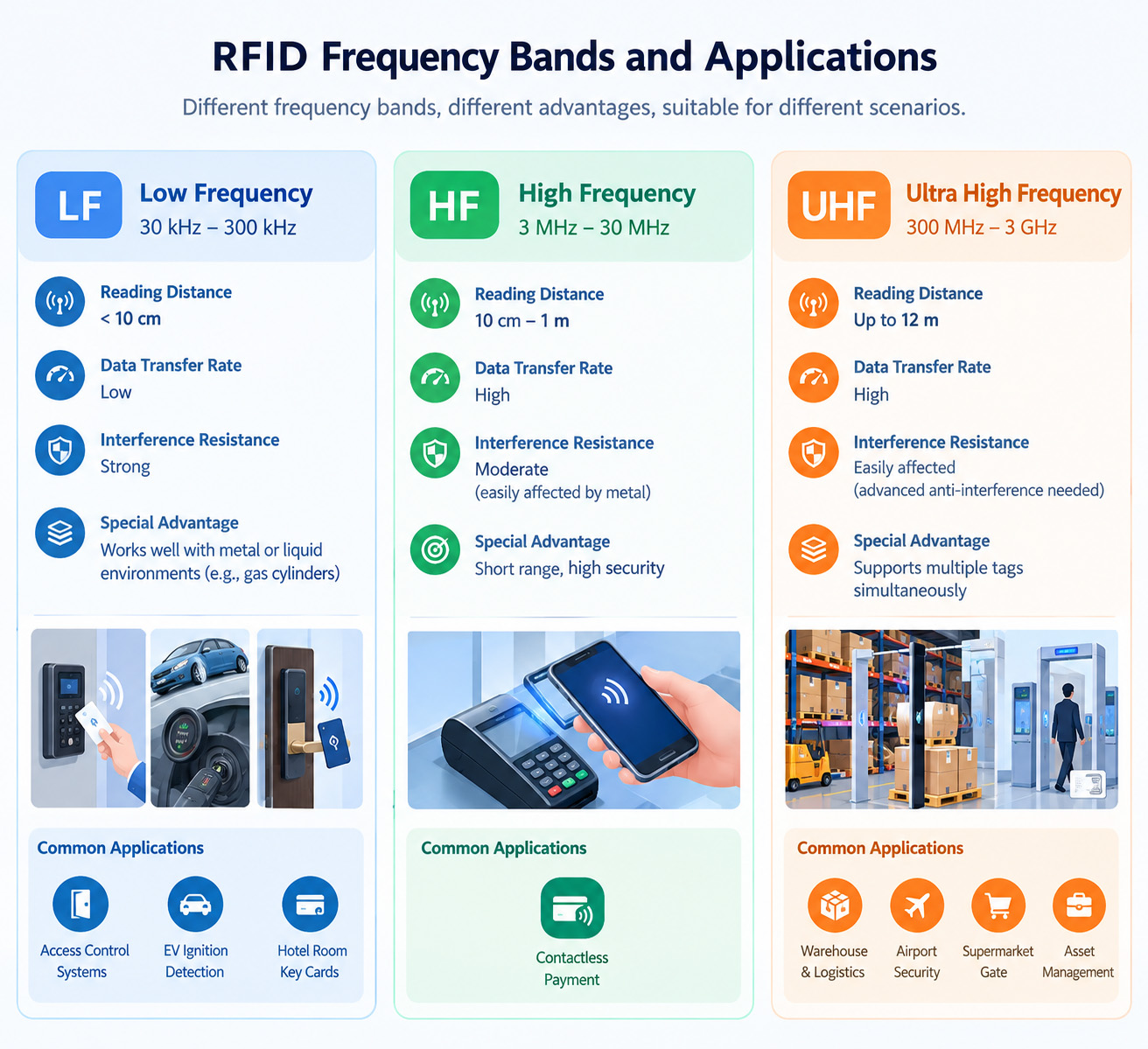
2.1 Classification by operating frequency: Low‑frequency RFID
Low‑frequency RFID features a short reading distance (<10-cm )and a low data‑transmission rate.It delivers strong anti‑interference performance and works well in metal or liquid‑rich environments (e.g., gas cylinder management).
Frequency range: 30 kHz‑300 kHz
Applications: access‑control systems, electric‑door sensing for new‑energy vehicles, hotel room key cards, etc.
2.2 High‑frequency RFID
Reading distance: 1 cm‑1 m
It provides a relatively high data‑transmission rate.It is susceptible to metal interference and is suitable for short‑range scenarios requiring high‑level security.
Frequency range: 3 MHz‑30 MHz
Applications: contactless payment
2.3 Ultra‑high‑frequency (UHF) RFID
Reading distance: up to 12 meters; it supports simultaneous reading of multiple tags.It is vulnerable to interference, so proven anti‑interference technologies are required.
Frequency range: 300 MHz‑3 GHz
Applications: warehousing and logistics, airport security screening, supermarket gate barriers, asset management, and so on.
3. Specific Application Cases of RFID Antenna Technology
RFID technology has a wide range of practical applications; however, different scenarios impose varying requirements on RFID antennas regarding operating frequency, read range, size, directivity, interference resistance, and installation method. Consequently, an RFID antenna is not simply “better” just because it is larger or has a longer read range; rather, it must be matched and tuned according to the device structure and the application environment.
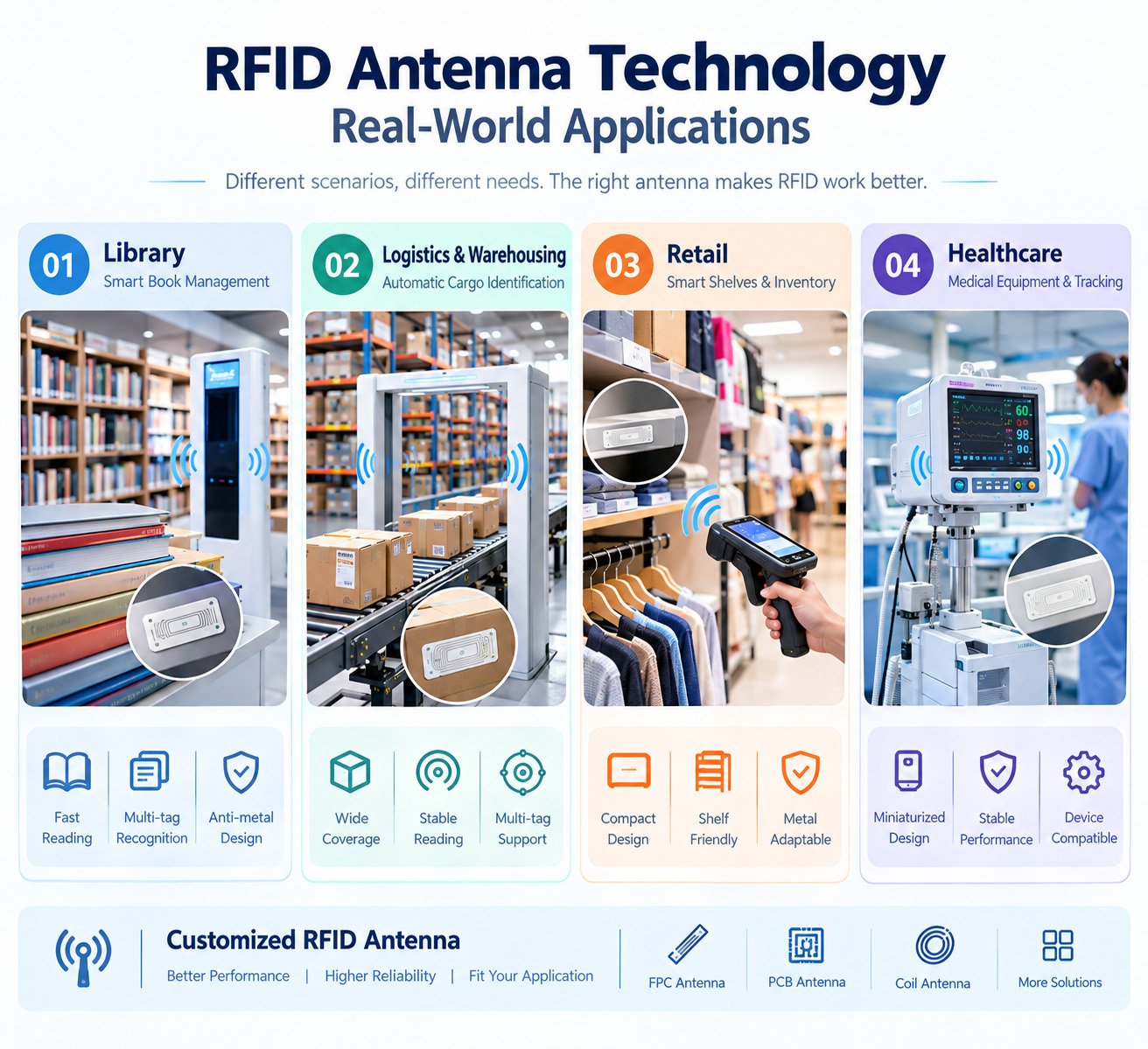
3.1 Libraries: Smart Book Management RFID tags placed inside books allow readers and antenna technology to identify book numbers and codes. This assists staff with rapid identification, inventory taking, circulation (borrowing/returning), and anti-theft management, thereby reducing workload and improving efficiency.
Key antenna design considerations:
- ・ Stable tag reading capability
- ・ Simultaneous multi-tag identification
- ・ Effective read zone coverage
- ・ Mitigation of performance degradation
3.2 Logistics and Warehousing: Automated Cargo Identification
RFID is utilized for managing logistics pallets, cargo containers, parcels, and assets. For instance, when RFID readers and antennas installed at warehouse entrances detect goods passing through the identification zone, the system automatically reads multiple tags and transmits the data to the warehouse management system.
Key antenna design considerations:
- ・Large read coverage area
- ・ Stable read range
- ・ Multi-tag identification capability
- ・ Tolerance for variations in cargo orientation
- Antenna size and radiation pattern adjusted to fit passageway dimensions
4. Why is antenna customization necessary?
>As the applications above demonstrate, even when using the same RFID technology, different products may have vastly different antenna requirements.
>In actual projects, antennas usually undergo a process of RF design → Prototyping → Tuning → Testing → Mass Production to ensure stable RFID identification performance. For devices with limited space, significant metal interference, or specific read-range requirements, customized RFID antenna designs—such as FPC antennas, PCB antennas, coil antennas, and other bespoke solutions—can be developed based on the product structure.
If you require custom RFID antenna development, please contact ANWEI. We provide technical support and serve as a manufacturer capable of delivering high-quality antenna solutions tailored to customer needs.