
How to Choose a GNSS Positioning Antenna?
When developing a positioning solution, many engineers spend a great deal of time researching GNSS modules, such as UM982, UM980, and u-blox ZED-F9P, but few realize that the factor that often determines the quality of satellite reception is not the GNSS module, but the positioning antenna.
Even with the same GNSS module, using different antennas can result in significant differences in satellite acquisition speed, RTK fix time, positioning stability, and even centimeter-level positioning accuracy.
So, what types of GNSS positioning antennas are available on the market, and how do you choose a GNSS positioning antenna? In this article, we will combine practical project experience to help engineers quickly select the right positioning antenna for their applications.
There Is No Best Antenna, Only the Most Suitable Antenna
Many customers ask during their first consultation: Which GNSS positioning antenna is the best? In fact, there is no single “best” positioning antenna. The right choice depends on the specific application and requirements.
When selecting and recommending a GNSS positioning antenna, we generally consider several factors:
- Required positioning accuracy
- Whether RTK is supported
- Operating environment and application scenario
- Required frequency bands, such as L1, L2, and L5
- Cost and budget
What Are the Common Types of GNSS Antennas?
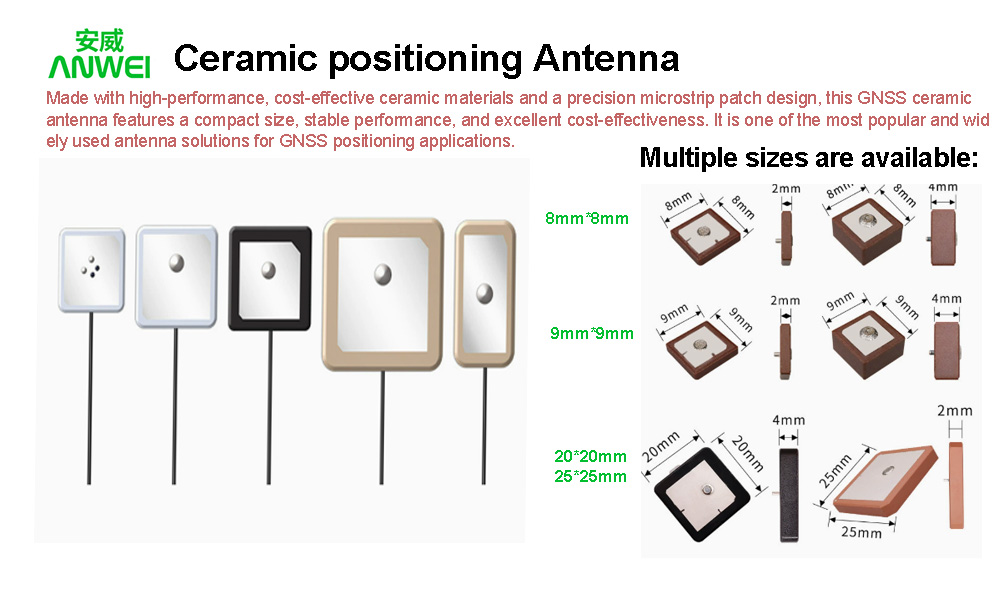
1. Ceramic Positioning Antenna — The Most Widely Used
Ceramic positioning antennas are one of the most widely used types of GNSS positioning antennas. They offer:
- ✅ Low cost
- ✅ Stable performance
- ✅ Multiple size options
- ✅ Easy integration
Common sizes include:
- ✅ 8 × 8 mm
- ✅ 9 × 9 mm
- ✅ 20 × 20 mm
- ✅ 25 × 25 mm
They are widely used in RTK modules, drones, robots, smart agriculture equipment, and surveying and mapping terminals.
2. Mushroom-Shaped High-Precision GNSS Antenna
The mushroom-shaped antennas commonly seen on the market are generally high-precision GNSS antennas. Depending on their internal structure, they may use different designs, such as air-dielectric structures or high-frequency PCB materials.
Compared with conventional ceramic antennas, they typically offer:
- ✅ Better multi-band performance
- ✅ More stable phase-center characteristics
- ✅ Stronger multipath mitigation
- ✅ Better suitability for centimeter-level RTK positioning
3. Magnetic-Mount GNSS Antenna — Easy Installation for Vehicle Applications
The biggest advantage of this type of antenna is its convenient installation. With a magnetic base, it can be quickly mounted on the roof of a vehicle or on a metal platform.
Magnetic-mount GNSS antennas are mainly used for vehicle testing, RTK debugging, engineering vehicles, inspection vehicles, and other mobile applications.
4. Aviation GNSS Antenna and Quadrifilar Helix Antenna
These types of antennas are mainly used in drones, fixed-wing aircraft, helicopters, and marine vessels.
Compared with conventional products, they typically feature:
- ✅ Better aerodynamic design
- ✅ Stronger waterproof and vibration resistance
- ✅ More stable positioning performance under high-dynamic conditions
How to Choose the Right GNSS Positioning Antenna?
Based on the characteristics above, engineers can select the most suitable GNSS positioning antenna according to their specific application requirements:
1. Limited budget and need for a compact product:Choose a ceramic positioning antenna.
2. Centimeter-level RTK positioning:A high-precision GNSS antenna is recommended.
3. Vehicle applications:A magnetic-mount GNSS antenna is a practical choice.
Ultimately, choosing a GNSS positioning antenna is not simply about selecting the antenna with the highest specifications. The best solution should be determined by the required positioning accuracy, frequency bands, installation environment, product dimensions, and overall budget.