What type of Bluetooth antenna is best for IoT devices?
Today, Bluetooth Antennasare an essential component of most connected smart devices. A Bluetooth module requires not only a core chipset and RF circuit, but also a critical component—the antenna—to transmit and receive wireless signals effectively.
An antenna is a component designed to transmit or receive electromagnetic waves. In the transmitting process, it converts high‑frequency electrical current from the transmitter into electromagnetic energy that propagates through free space. During reception, the antenna converts electromagnetic energy from the surrounding environment into electrical signals that can be processed by the receiver. Therefore, the Bluetooth Antenna acts as an important energy conversion interface in the wireless communication system.
Key Points to Consider When Designing a Bluetooth Antenna:
1. Keep Sufficient Clearance Around the Antenna
High‑frequency signals, especially signals above several hundred MHz, can be affected by surrounding conductive materials and ground structures. Therefore, sufficient clearance should be maintained between the antenna and nearby ground or metal components. In practical PCB antenna designs, the required clearance should be determined according to the antenna structure, frequency, PCB stack‑up, and simulation results rather than using a fixed distance for every design.
2. Pay Attention to Impedance Matching
For microstrip and stripline structures, characteristic impedance is closely related to PCB thickness, trace width, dielectric constant, copper thickness, and layer structure. Proper impedance control is particularly important for a 2.4GHz Bluetooth antenna, as impedance mismatch can increase reflection and reduce overall RF efficiency.
3. Minimize Vias in the RF Signal Path
Vias introduce parasitic inductance and capacitance into high‑frequency circuits. These parasitic effects can influence impedance matching and increase RF losses, especially at 2.4GHz. Therefore, the RF transmission line should generally be kept as short and direct as possible, with unnecessary vias avoided in the RF path.
Comparison of Common Bluetooth Antenna Types
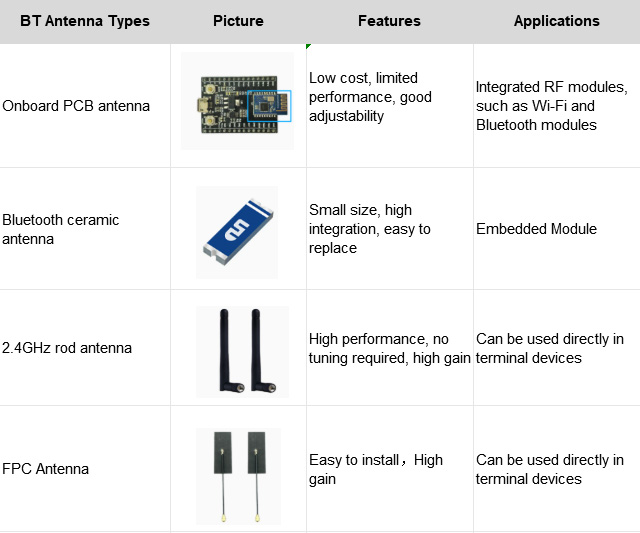
Next, let’s compare four common antenna types used in wireless and Bluetooth‑enabled devices, including their structures, advantages, limitations, and typical applications.
- 1. FPC Bluetooth Antenna
Flexible thin‑film structure, self‑adhesive for pasting inside devices. Small size, bendable. Low cost, widely used. Limited performance in thick metal housing.
- 2. PCB Trace Bluetooth Antenna
tched directly on main PCB board, no extra parts. Zero assembly cost. Requires reserved PCB space; poor performance if surrounded by metal.
- 3. Ceramic BT Antenna
Compact ceramic block, high integration. Stable performance. Higher unit cost, cannot bend; sensitive to surrounding metal layout.
- Spring‑Wire BT Antenna
Metal spring struc ture, good gain. Needs vertical installation, occupies height space; vulnerable to mechanical deformation.