
How to Choose an IoT Antenna : Whip, PCB, Chip, or Patch Antenna?
Choosing the right loT Antenna can be a real challenge for engineers: it needs to be compact, cost-effective, and deliver excellent RF performance. It often feels like an impossible triangle where you can’t have all three.
The ideal antenna may look perfect on paper, but real-world applications are often very different.
In this article, we’ll use one comparison table and four typical application scenarios to explain the fundamental logic behind IoT Antenna selection and help you choose the right antenna for your device.
1. One Table to Understand 7 Types of loT Antenna
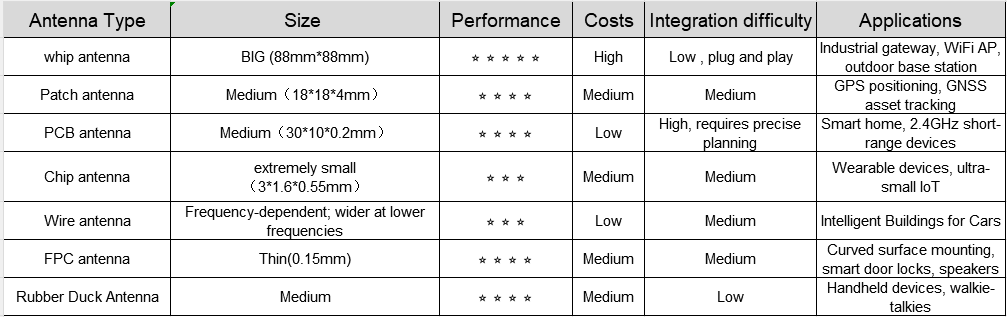
The most commonly used IoT Antenna types include whip antennas, rod antennas, rubber duck antennas, patch antennas, PCB antennas, chip antennas, wire antennas, and FPC flexible antennas. Their key features are summarized below:
2. Understanding the Datasheet: 4 Key Parameters
Choosing an IoT Antenna is not just about selecting the right antenna type. You also need to understand the key performance specifications in the datasheet.
① Voltage Standing Wave Ratio (VSWR)
VSWR is a key indicator of how well the antenna matches the transmission line. The ideal value is 1.0, meaning maximum power transfer with zero reflection.For most IoT Antenna applications, a VSWR below 2.0 is generally acceptable. When VSWR exceeds 2.5, a significant portion of the input power is reflected back instead of being radiated.
② Efficiency
Antenna efficiency shows how much of the input power is actually converted into radiated energy. It is one of the most important performance indicators for an loT Antenna.Generally, an antenna efficiency below 50% may be considered relatively low, while efficiency below 30% can significantly affect wireless communication performance.
③ Gain
Gain describes how effectively an antenna concentrates energy in its strongest radiation direction. It is usually measured in dBi, with an isotropic antenna defined as 0 dBi.Higher gain does not always mean better performance. For devices requiring omnidirectional coverage, such as mobile and wearable IoT devices, excessive gain may create a narrower radiation pattern and reduce coverage in certain directions.
④ Radiation Pattern
The radiation pattern represents the antenna’s three‑dimensional coverage area.Omnidirectional antennas are suitable for IoT applications where the communication direction is not fixed, while directional antennas are better suited for point‑to‑point communication and longer‑range transmission.
3. Match Antennas to Four Typical Scenarios
Scenario 1: Ultra‑compact Wearable Devices – Chip Antenna Selection
The chip antenna is the top choice under extreme space constraints. The Amphenol ST0147 features compact dimensions of only 3.05×1.6×0.55 mm and supports direct SMT mounting, with a peak efficiency of 80%. Its drawbacks lie in its typical efficiency of merely 40%‑50%, and its performance is highly susceptible to PCB layout and surrounding components, which is a common consideration for IoT Antenna design.
Scenario 2: Smart Home / Thermostats – PCB Antenna Selection
PCB antennas deliver ultra‑low cost (zero BOM cost) with moderate size and can achieve up to 77% efficiency. Key design tips: Place the antenna at the PCB corner, reserve a clear keep‑out area around it, and keep antenna traces away from ground planes and metallic components.
Scenario 3: Outdoor Gateways / Industrial loT Antenna– Whip or Rod Antenna Selection
When performance and reliability are priorities, external whip antennas serve as the optimal solution. The Amphenol ST0226 provides omnidirectional radiation across 2.4 GHz / 5 GHz bands, with efficiency of 86% / 75% and gain of 3.0 / 3.4 dBi. An IP67 or higher ingress protection rating is required for outdoor deployment.
Scenario 4: GPS Positioning / Asset Tracking – Patch Antenna Selection
Patch antennas are optimized for satellite communication and support RHCP / LHCP circular polarization, boasting efficiency above 80%. Key selection note: Patch antennas must face the sky and shall not be obstructed by metal overhead.